
In 30 seconds
- 1
Writing in the late Ming, Ji Cheng put it in one line: “Though made by people, it should seem to arise from nature.” Every rock and pool here is artifice; the art is that you should not notice.
- 2
A garden is a handscroll you walk into. Windows, doorways and corridors compose the view for you, and every step changes the picture.
- 3
Name boards and couplets are the garden’s footnotes. Understand a name, and you often understand the view in front of you.
The governing of a clumsy man
In 1509 the censor Wang Xianchen, out of office and home in Suzhou, began a garden on the abandoned grounds of former temples in the north-east of the city. He named it with a wry line from the Jin-dynasty writer Pan Yue: watering a garden and selling vegetables “is also the governing of a clumsy man”. Retirement was a defeat, and also a stance.
Once the garden took shape, Wen Zhengming of the Wu school painted its scenes and wrote poems for them, later gathered as the Thirty-One Views of the Humble Administrator’s Garden. Scenery and words were made together from the start: first a view worth naming, then the name — and the name in turn told later visitors how to look.
Today the garden has eastern, central and western parts, the central one arranged around its pond. In 1997 it was inscribed on the World Heritage List with the Lingering Garden, the Master of Nets Garden and the Mountain Villa with Embracing Beauty; after an extension in 2000, the Classical Gardens of Suzhou number nine.
On the spot
01
Four moon gates: looking still, looking in motion
Where to standThe Wutong and Bamboo Pavilion, at the east end of the central pond.
The square pavilion has a round opening in each of its four white walls. Stand inside and turn: each circle frames its own picture — water, trees, a distant hall — changing with the seasons. The rim of the opening is the frame, and whatever the designer did not want you to see is cropped away.
A couplet hangs inside: “For coolness borrow the breeze, for brightness borrow the moon; watch flowing water in motion, watch the hills at rest.” One line is about borrowing, the other about looking. Sit, and you look in stillness at hills that do not move; rise and walk, and the water and the views keep changing. Most of the garden’s way of seeing is in these fourteen characters.
NoticeSit first and look across the water through one opening. Then walk a few steps along the pond and look back at the same spot. Still and moving, the two views are not the same garden.
02
The borrowed pagoda
Where to standThe east end of the central pond, near the Yihong Pavilion, looking west.
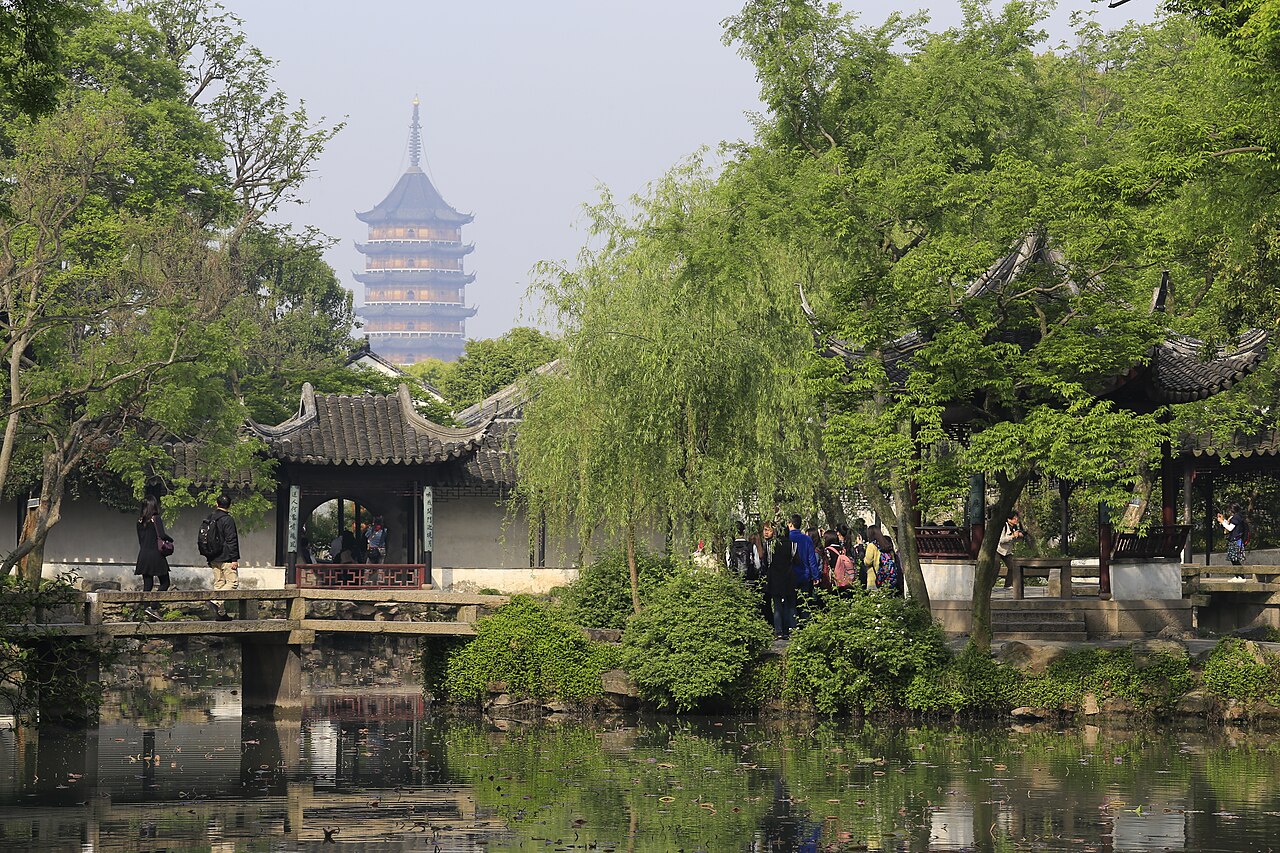
Look west along the water and a pagoda rises above the treetops. It is the North Temple Pagoda of Bao’en Temple, outside the garden, with streets and houses in between. Yet from here it sits exactly at the far end of the water, between two masses of trees, as if it had always belonged to the garden — its reflection falls into the pond.
Ji Cheng wrote that a garden’s skill lies in “borrowing from what is there”, its refinement in fitting the setting; and that “though a garden divides inside from outside, a good view knows no limit of distance.” A wall can separate the garden from the city, but not the eye. Borrowing is half taking in and half screening out — trees and pavilions hide the town between, so that, in his words, “the vulgar is screened and the fine is gathered in”.
NoticeOnce you find the pagoda, find what inside the garden is mounting it like a painting: the low bridge in front, the trees on either side, the pavilion roof beyond. Take any one away and the picture falls apart.
03
Hidden and revealed, near and deep
Where to standNear the Fragrant Isle boat-hall in the south-west of the central garden, looking south.
The Fragrant Isle is a stone boat, its prow over the water. Look south: the covered bridge called Little Flying Rainbow spans the pond, behind it the Dezhen Pavilion, and behind that the Little Canglang water court, one layer beyond another. The bridge does not block the view; you see further water beneath it, and the space reads deeper than it is.
The Qing writer Shen Fu described the art of making gardens as showing “the small within the large and the large within the small, the solid within the void and the void within the solid — now hidden, now revealed, now shallow, now deep.” The view south from the Fragrant Isle is a lesson in hiding and revealing. Inside the boat-hall a large mirror reflects the far bank into the room — another kind of borrowing.
NoticeCount the layers between you and the farthest point: water, bridge, pavilion, wall. Then walk onto the bridge and count back the other way.
04
The moon, the breeze, and I
Where to standThe “With Whom Shall I Sit?” Pavilion, by the water in the western garden.
This small pavilion sits on the water in the shape of an open folding fan; its table, stools, windows and doors are fan-shaped too. The name comes from a lyric by Su Shi: “Idly I lean on a folding chair; beyond Lord Yu’s tower, a thousand peaks. With whom shall I sit? The bright moon, the clear breeze, and I.”
Su Shi is writing about solitude, but a solitude at ease: with no one to sit beside, he sits with the moon and the wind. There is nothing precious in the pavilion; what you are meant to look at is the water, the breeze and the moonlight. A single name decides how this place is to be seen.
NoticeFind another name board in the garden. Guess which part of the view it names, then check the sign. The moment name and view meet is when the garden begins to speak.
A garden never finished
The garden was not built once and handed down intact. Over five centuries it changed owners again and again, and was divided, neglected, rebuilt and restored; what you see today is many layers laid one over another.
Even the North Temple Pagoda is absent from Wen Zhengming’s thirty-one views. It became the garden’s most famous picture after obstructions around it were cleared in the 1990s, ahead of the World Heritage nomination. “Seeming to arise from nature” is the work of generation after generation; to look at a garden is also to look at how people keep rewriting it.
Going further
- On your ownThe distance of a windowTake one lattice window. Look from close up, then from three steps back. Somewhere between lies the distance the garden’s maker intended.
- OfficialHumble Administrator’s Garden — official siteThe reference for opening times, tickets and reservations.
- OnlineUNESCO: Classical Gardens of SuzhouWhy the nine gardens are on the World Heritage List.
Before you go
- Tickets & reservations
- See the official site
- Steps & paths
- Not yet verified
- English guiding
- Not yet verified
Being a good guest
- Lattice windows, carvings and name boards are often old: do not lean on or touch them for a photograph.
- Corridors and the covered bridge are narrow: step aside to take a picture, and do not hold a window for long.
- Rockeries and stone banks are not paths: stay behind the railings.
- The pond is not a wishing well: no coins, no feeding.