
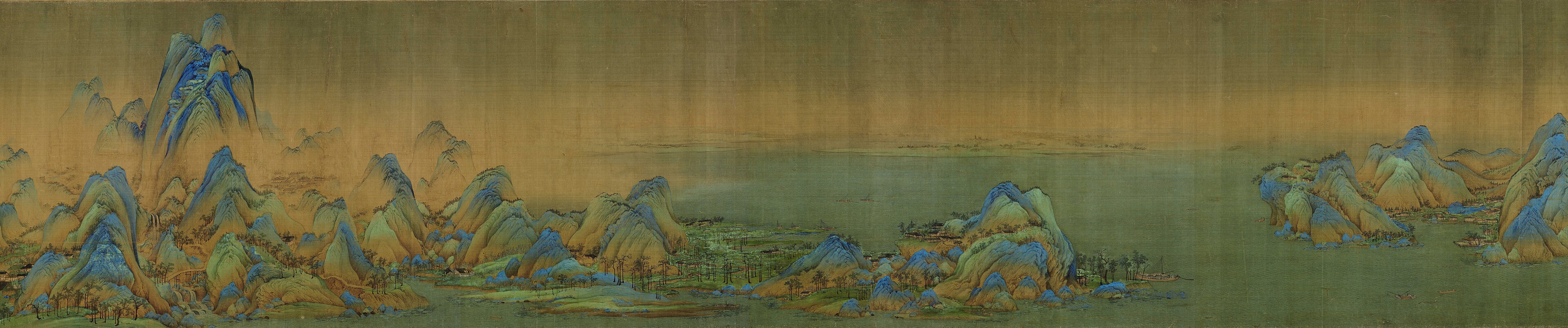
Rivers and mountains,read like a scroll
From the jade of Liangzhu to the axis of the Forbidden City, from a cup of tea to a walled garden — landscapes, objects, seasons and customs are all a kind of writing, and all of it can be read.
Scroll
From Liangzhu to today
c. 3300 – 2300 BCE
Early civilisations
Distinct early cultures rose along the Yangtze, the Yellow River and beyond. Liangzhu already had city walls, a palace area and large-scale waterworks.
- One object
- Liangzhu jade cong
- Where to see it
- Liangzhu ruins · Hangzhou
c. 1600 – 256 BCE
Shang, Zhou & the thinkers
Shang oracle-bone script is the earliest known system of Chinese writing, alongside ritual bronzes. Later, Confucius and rival schools debated how to live and govern.
- One object
- Oracle bones
- Where to see it
- Yinxu · Anyang
221 BCE – 220 CE
Qin & Han
Qin standardised writing and measures. Han envoy Zhang Qian travelled west, and the exchange networks later called the Silk Roads took shape.
- One object
- The Terracotta Army
- Where to see it
- Emperor Qinshihuang’s Mausoleum · Xi’an
220 – 907
Division to the Tang
Buddhist cave art flourished. The Sui dug the Grand Canal, and Tang Chang’an became a cosmopolitan capital — the high age of Chinese poetry.
- One object
- Mogao murals
- Where to see it
- Mogao Caves · Dunhuang
960 – 1368
Song, Liao, Jin & Yuan
Several states coexisted and traded. Cities thrived, movable type appeared, and porcelain and sea trade boomed. This page’s painting dates from this era.
- One object
- Along the River at Qingming
- Where to see it
- Palace Museum · Beijing
1368 – 1912
Ming & Qing
The Forbidden City was completed in 1420, Zheng He’s fleets sailed the Indian Ocean, the Great Wall was rebuilt in brick, and novels and opera reached city streets.
- One object
- The Forbidden City
- Where to see it
- Forbidden City · Beijing
1840 – 1949
Into the modern age
An age of upheaval: imperial rule ended in 1912, and railways, factories, newspapers and new schools transformed coastal cities.
- One object
- The Bund
- Where to see it
- The Bund · Shanghai
1949 – today
China today
The People’s Republic was founded in 1949, and reform and opening began in 1978. Cities, high-speed rail and museums reshape daily life, while traditions carry on in new forms.
- One object
- National Museum of China
- Where to see it
- Tiananmen Square · Beijing
Images
China, half familiar
Interests
Follow what draws you
- At the tableTea, breakfast, staples and shared meals — from what people eat to how they eat together.
- Hands & materialsPaper, clay, silk, cloth and ink — how a thing is actually made.
- Dress & lookingTelling museum pieces from reconstructions and modern wear — and respecting the person in the frame.
- Stage & soundOne gesture, one prop, one sung line — the conventions behind the stage.
- Buildings & evidencePalaces, gardens, caves and homes — where to stand and what to look for.
- Streets & daily lifeParks, lanes, markets and old factories — how people live and make things today.
- Seasons & beliefHow festivals are lived, and how to be a good guest in sacred places.
- Landscapes & exchangeTea forests, waterways, ports and landscape painting — the people and journeys inside a view.
Season
Autumn is a run of days with names
8 Oct
Cold Dew
“The dew grows cold and is about to freeze,” as the old almanac puts it. Leaves turn in the north while the south is only just cooling.
18 Oct
Double Ninth Festival
The ninth day of the ninth lunar month. Wang Wei wrote of brothers climbing the heights with dogwood in their hair, “and one of us missing”. People climb hills, admire chrysanthemums and visit elders; it is also Seniors’ Day.
23 Oct
Frost’s Descent
“The air grows austere, and dew becomes frost.” The last solar term of autumn: first frost in the north, persimmons at their reddest.
- The Palace MuseumSix centuries of palace, and the collections inside it
- Digital DunhuangWalk into the Mogao caves in high resolution (Chinese only)
- National Museum of ChinaThe “Ancient China” galleries, from prehistory to the Qing
- Chengdu Research Base of Giant Panda BreedingMeet the pandas before you go
- UNESCO · World Heritage in ChinaWhy each site is worth protecting