In 30 seconds
- 1
Read gates, bridges, terraces and courtyards. The central axis makes order visible; side routes reveal its everyday complexity.
- 2
From a clear position, describe where your eye falls before and after a gate.
- 3
Count visible bridges and relate them to gates and buildings without crossing barriers.
A way into the subject
The Forbidden City served the Ming and Qing emperors and now opens as the Palace Museum. Its halls are not a random assembly: gates, walls, courtyards, terraces and axes organise space and levels of access. Look beyond roofs. Compare what is visible on the two sides of a gate; this can explain space better than collecting famous hall names. Solemnity comes from scale, distance, sightlines and access working together, rather than red walls and yellow tiles alone.
The central route makes relationships between the main ceremonial halls and inner court legible, while many buildings lie east and west. Outer and inner court help distinguish formal ceremony and residential life without fixing every building to one timeless purpose. Fire, rebuilding, repair and changing use have shaped the palace; museum exhibitions add another layer. Check open and protected areas as you go. A current repair notice concerns the Gate of Supreme Harmony, so the observations here are not instructions to pass through it.
On the spot
01
A gate changes what you can see
Where to standOpen courtyards inside the Meridian Gate and beside accessible gates.
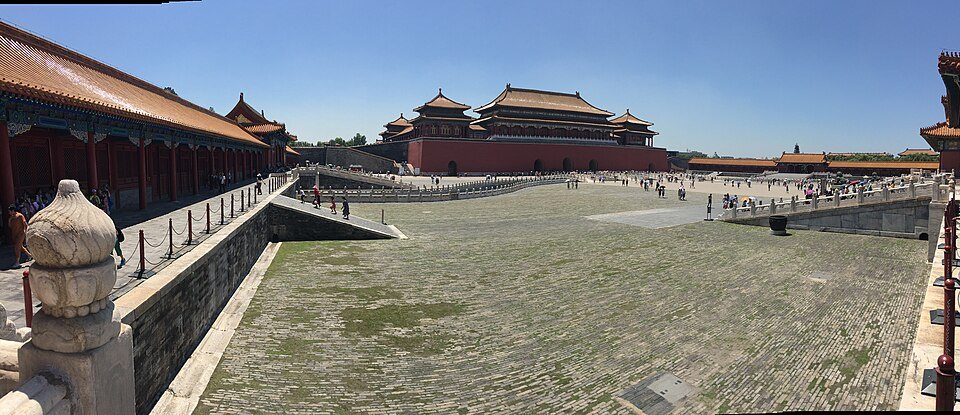
A wall and gatehouse outside can give way to a broad space inside. Openings do not all have identical functions, and today’s visitor route differs from historical ranked access. Compare a gate’s depth and dark passage with the bright court beyond, then see whether the next building faces you. Do not walk against the flow or occupy a checkpoint for an empty doorway image.
NoticeFrom a clear position, describe where your eye falls before and after a gate.
02
Bridges organise movement
Where to standAn authorised stopping place near the Inner Golden Water River.
River and bridges make a court more than an open field to cross arbitrarily. Compare the bridges, curved watercourse and distant steps organising direction; symmetry does not mean every route is available. Reflection can place buildings in the water again, depending on water and maintenance conditions. Without reflections, study circulation rather than treating one view as a permanent standard.
NoticeCount visible bridges and relate them to gates and buildings without crossing barriers.
03
Terraces give scale to the body
Where to standThe open court before the Hall of Supreme Harmony.
A terrace lifts a building and steps lengthen its approach. People look small in a broad court, making the hall seem farther and weightier. Follow the horizontal layers of rails, stairs, paving and eaves rather than concentrating only on roof figures. Other visitors supply scale: people in a photograph can help explain the courtyard’s actual size.
NoticeUse a distant person for scale and compare terrace height with hall width.
04
Smaller spaces off the axis
Where to standOpen east or west visitor areas.
Off the grand courts, spacing, sightline length and relationships change. Smaller spaces reveal window and wall detail without being devoid of institutional meaning. Notice lateral routes supplementing the axis and exhibitions occupying old buildings. Follow the one-way route rather than walking back to the Meridian Gate; recalling the larger court completes the comparison.
NoticeDescribe an open small courtyard with three scale words, then compare the main ceremonial court.
How the tradition reaches the present
As a museum, the palace offers public access where historical entry was restricted, while access must work with conservation. Repair can temporarily close a gate or hall without removing the subject: rivers, walls, courts and adjacent buildings still explain relationships. Present structures are not all untouched survivors of the first Ming construction. Consider restoration, rebuilding and use together rather than a frozen dynastic backdrop. Afterwards use the official panorama and map to place your route within the whole.
Going further
Before you go
Being a good guest
- Do not touch woodwork or carvings or lean on rails for poses.
- No smoking or marking buildings or trees.
- No flash or tripods in galleries.
- Keep doorways and steps clear and follow the one-way route.