In 30 seconds
- 1
Look for the slender bridges that keep the sheet connected.
- 2
Folding can create symmetry, but there is no single universal method.
- 3
Use and the maker’s account explain more than a generic symbol dictionary.
One sheet, many social relationships
The national heritage account of Zhongyang connects paper-cutting with seasonal occasions, life ceremonies, beliefs and stories, and with the work of rural women. Even within the county, different areas have more delicate or more robust styles. These objects need not have begun as framed artworks: their placement and occasion mattered. Ask where a design was used and when, so that its role in someone’s life becomes more visible.
Yuxian reminds visitors that paper-cutting need not involve scissors alone. Its carving and applied colour developed a distinctive approach, while motifs drew on other folk-image traditions. Zhongyang in Shanxi, Yuxian in Hebei and a Beijing introductory class can be compared without turning them into one regional practice. A template exercise introduces connection and empty space; understanding a local work requires its maker and provenance. Completing the exercise is a beginning, not mastery of a community’s culture.
On the spot
01
Find what keeps the design intact
Where to standA practice sample you may handle, or an image of a work.
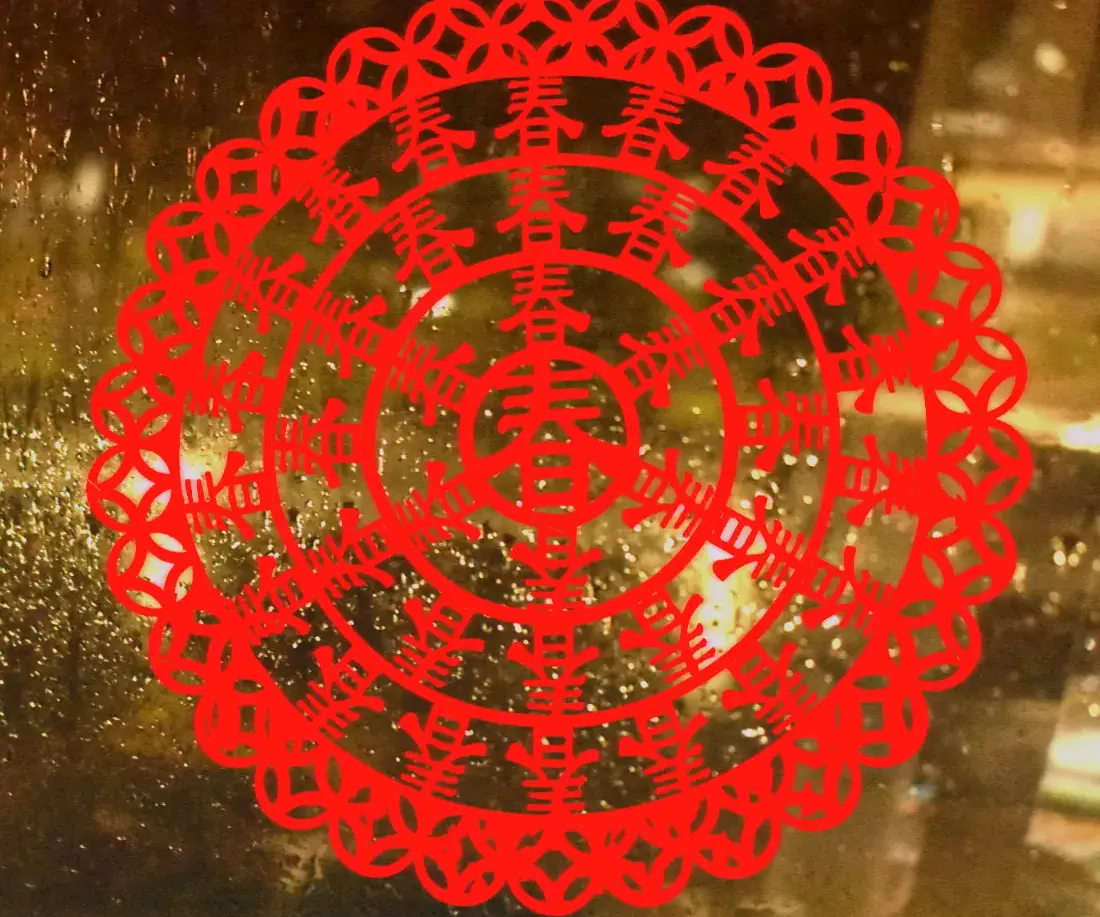
Trace a route from the outer edge into the centre. Paper bridges may connect a tail, petal or fold of clothing. Too narrow and they break; too wide and they can make the design heavy. Removed space contributes to recognition and transmitted light, rather than merely filling a background. Thinking of the work as a structural network explains why a connection that seems anatomically unusual may need to remain, and how the maker integrates support into decoration.
NoticeTrace an unbroken paper connection from edge to centre.
02
How an action creates symmetry
Where to standDuring folding and opening in a beginner exercise.
A folded sheet repeats an outline when opened. The surprise comes from a sequence of earlier actions. Observe crease positions and cut directions before predicting the repetitions. Not every symmetry needs a sweeping cosmological explanation; it can also be an efficient material technique. Makers may carve layered sheets, cut a single image or add colour. Both symmetrical and asymmetrical compositions are possible. An introductory exercise should reveal how the image emerges rather than become a race to finish.
NoticePredict the number of repetitions before opening the sheet.
03
A fish has more than one possible reading
Where to standA work accompanied by title, use or the maker’s explanation.
Fish and flowers often appear in celebratory images, yet meaning depends on language, occasion and arrangement. A figure may belong to an opera or story rather than being an anonymous ancient beauty; the same animal may serve different ritual settings. Identify the visible forms, then read the title and explanation and ask why they occur together. A precise description of shape is a valid starting point. Every paper-cut need not be compressed into wealth, longevity or luck.
NoticeName two elements and ask why the maker combined them.
04
Look at cut edges and applied colour
Where to standA comparison of Yuxian and single-colour works.
From a permitted distance compare edges, repeated lines and the reach of applied colour. Do not touch fine details to test whether a piece is handmade. Colour can separate figures and flowers; a single-colour work relies more on contour and gaps. Colour alone cannot prove origin, and tidy lines do not automatically establish machine production. Ask about technique, maker and provenance. A concrete explanation of process is usually more useful than an unsupported heritage label.
NoticeCompare how a coloured and a single-colour work separate their subjects.
From windows to new work
Exhibitions, schools, urban communities and commercial markets change the audience and introduce new materials or themes. Framed window decorations no longer encounter light and air in the same way, and enlarged installations require new support. Ask which connection methods remain, who makes the work and how its purpose has shifted. Buying attributed work or asking a thoughtful question can support a maker; treating a craftsperson as a performer available on demand cannot.
Going further
Before you go
- Digital starting point
- The Zhongyang and Yuxian project accounts are freely readable and useful before travel
- Participation
- Join announced cultural-centre or studio activities through their organisers; a heritage entry is not a bookable class
- Buying and carrying
- Ask for maker and technique when buying; transport flat between rigid boards to protect delicate connections
Being a good guest
- Do not remove decorations or enter a private courtyard.
- Ask before handling patterns, tools or layered sheets.
- Respect attribution and rights; do not sell a copied photographed design.
- Follow the instructor’s tool guidance and collect paper scraps.