In 30 seconds
- 1
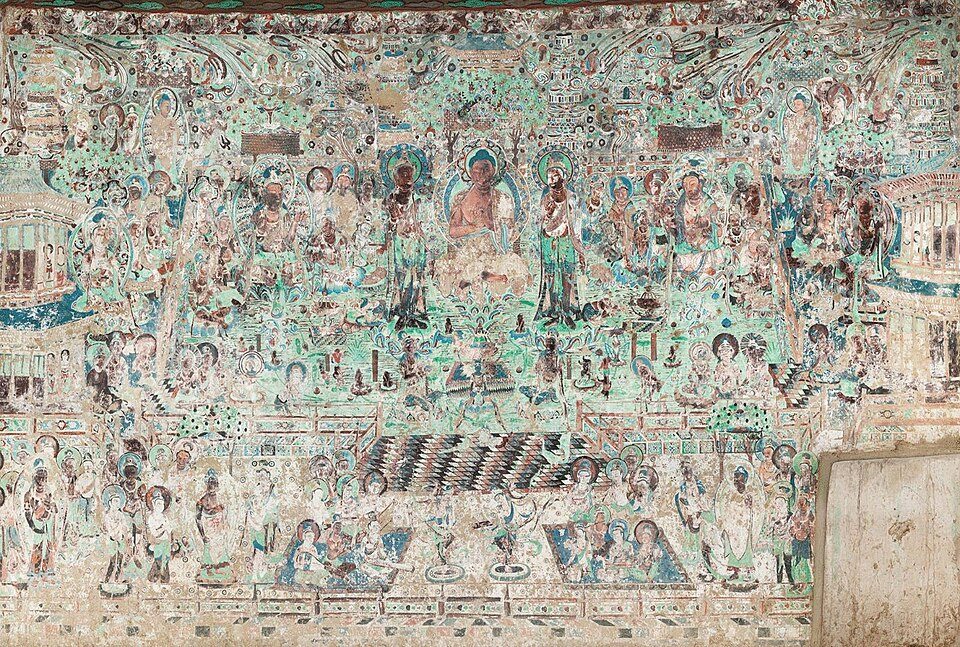
Look at central figures, ground and water, music and inscriptions. A religious image connects composition, materials and history without being a documentary photograph.
- 2
Reduce the image and indicate three imaginary lines connecting centre and sides.
- 3
Follow a platform edge to a figure’s feet and judge front and back.
A way into the subject
Mogao stands at a Silk Road meeting point, with sculpture and murals built over a long period. Cave220 is an important early Tang cave: its south wall shows the Western Pure Land, the north a Medicine Buddha composition and the east Vimalakirti. The Dunhuang Academy records early Tang paintings revealed beneath Song layers in1943, with inscriptions supporting a642 date. This is an object with covering, repainting and research history, not an untouched surface. Establish cave number, wall and theme before connecting images.
A Pure Land composition gives visible form to an ideal world in Buddhist texts. Figures, pools, platforms, buildings, music and dance form a scene rather than documenting a literal banquet. Digital Dunhuang lets you enlarge details; a visit reveals scale, lighting and surrounding space. These experiences complement each other. Standard tours do not guarantee Cave220: read it online and use the same questions in open caves. Bright colours in a reproduction should not replace understanding of actual viewing conditions.
On the spot
01
The centre is more than the largest figure
Where to standThe whole digital image.
Locate the central seated figure, then its flanking and surrounding groups. Size, position and orientation establish priorities; importance is expressed in several ways. A smaller image clarifies structure while enlargement can lose you in clothing. Describe relationships before identifying Amitabha and the two bodhisattvas through the official account. The stable centre and changing density at the sides make the image unfold beyond a single named figure.
NoticeReduce the image and indicate three imaginary lines connecting centre and sides.
02
How earth, water and sky connect
Where to standUpper and lower parts.
The Academy describes ground, watery realm and sky. See how rails, steps and platforms connect levels. Waterborne buildings organise an imaginable world rather than a modern perspective plan. Follow an edge hidden by a figure to examine front and back. Solemnity and lively music work together. Do not force every building into modern surveying proportions; ask what the painter needed visible at the same time.
NoticeFollow a platform edge to a figure’s feet and judge front and back.
03
Music gives detail and raises questions
Where to standThe lower musical scene.
Compare hands, feet and instruments without asserting a precise technique from a blurred image. Murals inform clothing, instrument and gesture research while reflecting religious purpose, workshop conventions and conservation. A depicted instrument can differ from its present-day namesake. Record outline, direction and holding position separately to distinguish sight from modern inference. A good question can be more valuable than a confident identification.
NoticeCompare only visible hand positions and instrument directions of two musicians.
04
Colour and inscription record time
Where to standDigital detail and the official explanation.
Pigment change, covering, loss and uncovering affect survival. Darkened flesh need not be the original choice, and a bright reproduction may be processed. Inscriptions contribute dating evidence alongside position, text and research. Never touch walls or add light to clarify a detail; revisit online. Cracks and depicted content belong to different layers, and imagination cannot restore missing parts as certain facts.
NoticeNote one loss, one clear area and a date supported by inscription.
How the tradition reaches the present
Access balances conservation, environment and capacity. Digital displays help visitors prepare and reduce repeated study inside. Research continues beyond slogans. Compare another period’s Pure Land centre, platforms, colours and density, describing a difference rather than only greater elaboration. Establish original painting, later repainting or digital reconstruction. Media change emphasis too: screens enable close reading while a cave places images back in space around the body.
Going further
Before you go
- Standard full-price tickets
- High season238yuan with digital films and8caves; low season140yuan with films and10caves. Standard admission does not promise a particular cave.
- Booking and slots
- Choose date, time and ticket category officially and follow order arrival instructions; the venue determines open caves.
- Cave220 close reading
- Use Digital Dunhuang online; ordinary tickets do not promise a named cave.
Being a good guest
- No photos, video, flash or personal light inside caves.
- Do not touch murals or sculpture or lean on walls.
- Follow the guided group and stay out of closed caves.
- Follow fire and food rules and keep the site clean.