In 30 seconds
- 1
Start with standing, containing and use before ornament.
- 2
Blue-and-white uses underglaze cobalt; other colours can involve different processes.
- 3
Fragments and repair lines reveal production and preservation.
Porcelain as coordinated work
Jingdezhen’s China Ceramics Museum brings together objects from different periods, allowing comparison across a long production history. Making porcelain involves preparing material, forming, trimming, decorating, glazing and firing; complex vessels can include separately made and joined components. Attributing every result to the final signature overlooks material preparation, kiln work and other roles. Study a process diagram, then return to one vessel and ask which decisions and skills each part required.
Porcelain cannot be distinguished from other ceramics by a single test such as a clear ringing sound, and museum objects must never be struck for that purpose. Body, firing and glaze matter together. Blue-and-white offers a useful starting point: cobalt decoration lies beneath the glaze and becomes part of the fired object. Kiln sites, supports and sherds restore the production context, reminding viewers that successful pieces existed alongside selection, failure and reused material.
On the spot
01
Mouth, belly and foot
Where to standA display case giving a clear silhouette.
Follow the silhouette: does the rim flare or contract, how does the shoulder meet the belly, and how does the foot support the weight? A bottle, bowl and plate differ in the demands of containing, pouring and placing. An unglazed foot can reveal body material more directly than the decorated front. If the bottom is hidden, do not invent it. Record what is visible and use collection photographs from other angles to continue the comparison.
NoticeDescribe mouth, body and foot before reading the object name.
02
Glaze has material depth
Where to standA permitted side view where reflections reveal the surface.
Glaze is more than painted colour: firing forms a surface over the body. From another permitted angle, watch reflected light move across the belly, consider whether recesses look deeper and whether the rim reveals another tone. Crackle, bubbles and firing variation describe different phenomena; an uneven surface is not automatically damage, nor a basis for independently declaring value. Reading it as a result of heat and material leads to better questions than asking price alone.
NoticeCompare the same reflection from two positions without touching the vessel.
03
A design around a curved surface
Where to standThe decorated area of a blue-and-white vessel.
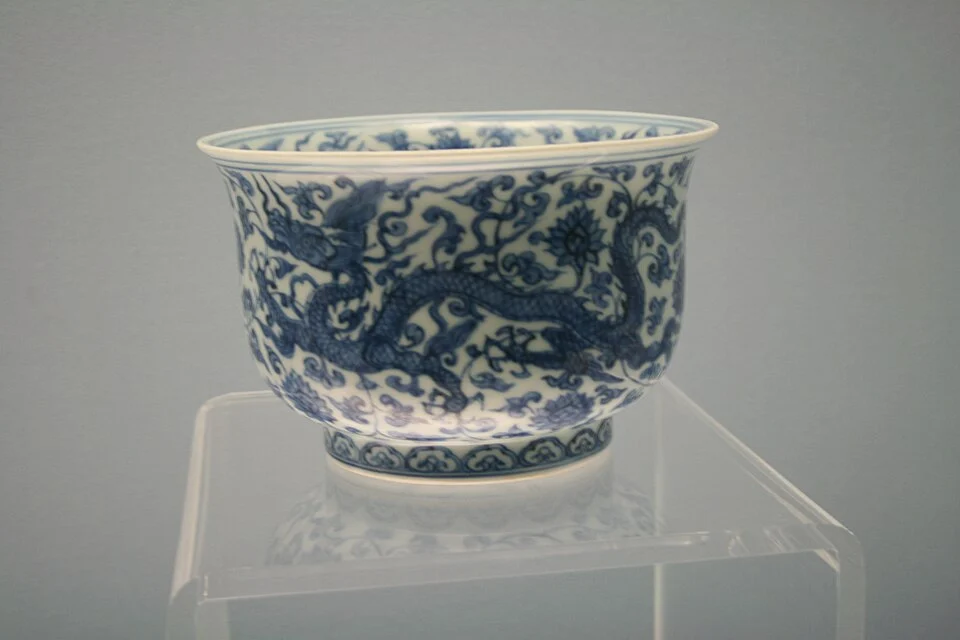
A design on a curved vessel responds to neck, shoulder and divided zones. Shoulder ornament may mediate between the neck and main scene, while borders circle rim and foot. Find repeating units and see how the design meets its own end. Tonal variation also depends on material and firing; a diffuse edge is not automatically a painter’s error. The label’s period and technical description help establish which features are useful to compare, rather than judging every object by the same ideal of sharpness.
NoticeFollow one border and compare its job with the main scene.
04
Fragments restore the production story
Where to standAt repaired objects, kiln furniture and archaeological interpretation.
A reconstructed vessel shows how a former surface is inferred from pieces. Repair lines are not original ornament. Kiln furniture explains support during firing, a function distinct from later use or display. Numerous similar fragments invite questions about production and selection rather than only regret that something broke. Archaeology makes working material into evidence, and reconstruction reveals the museum’s own organising labour. Note where the reconstruction is certain and where a label identifies additions or interpretation.
NoticeDistinguish a decorative line from a repair join and explain the evidence.
New makers in the porcelain city
Contemporary studios and designers continue to use Jingdezhen’s material and skill networks. A wheel session teaches balance in rotation, but a wet piece does not usually become a usable vessel the same day. Drying, glazing, firing and delivery need separate arrangements. Ask which stages you perform, which the studio completes and how deformation is handled. Understanding the remaining work makes the claim “I made this bowl” more precise and recognises the people who help bring it into use.
Going further
Before you go
Being a good guest
- Do not tap vessels or touch exposed body and repair lines.
- Use studio equipment only with permission; never open a kiln yourself.
- Ask before photographing makers and keep working paths clear.
- Clean up as instructed and confirm firing and delivery arrangements.